Batteries are Pakistan’s antidote to volatile fossil fuel prices
Investing US$500m in batteries plus renewables could save up to US$2.87bn in RLNG operating costs by 2030.
Summary
● Pakistan’s RLNG-dependent grid is highly exposed to global fuel shocks. Using IGCEP demand projections and locally sourced fuel prices, our partners, Renewables First, used Scenario Builder to model how the national grid responds to a combined oil and RLNG price shock in 2026 and 2030
● In 2026, when the system has no time to build new capacity, RLNG generation falls 94% as prices soar from US$72.6/MWh to US$89/MWh. Without grid-scale battery storage to deploy stored solar, the grid has no cheap, clean alternative. To fill the gap, coal surges from 1.7 TWh to 33.4 TWh
● In 2030, a US$488m investment in 1.16 GW of batteries and 2 GW of wind could reduce Pakistan’s exposure to fossil fuel price volatility and save the country up to US$2.87bn in RLNG operating costs. Accelerating batteries alongside grid-connected solar is the most effective near-term action for system planners
Pakistan's grid exposure to fuel shocks
Pakistan is uniquely susceptible to this ‘double-exposure’ of oil and RLNG shocks. The 2021-22 LNG price spike already showed how quickly this risk can materialise. As a price-taking importer with limited long-term supply alternatives, Pakistan has little control when prices spike and consumers bear the cost.
Pakistan's consumer-led solar boom has already reduced this exposure. Recent analysis from Renewables First and CREA found that distributed solar has avoided more than US$12bn in fossil fuel imports since 2018. Most of that solar, however, sits behind the meter, invisible to the national grid operator and unavailable for dispatch.
With these limitations in mind, we focus this analysis on the national grid: what happens when fossil fuel prices spike in the short and medium term? Using IGCEP demand projections and locally sourced fuel prices from Pakistan's power purchase documents, we model system response in 2026 and 2030 under a combined oil and RLNG price shock.
Model and scenario set-up
Four scenarios. Two time horizons. One price shock.
Our partners, Renewables First, ran hourly dispatch models for Pakistan’s national grid in 2026 and 2030 using TransitionZero’s Scenario Builder. The 2026 scenarios represent a rigid system with fixed capacities — no new infrastructure can be built overnight in response to a price shock. The 2030 scenarios allow for capacity expansion, reflecting a system that has had time to invest. Within each year pair, the only difference is the fuel price applied to RLNG and oil.
These scenarios deliberately exclude behind-the-meter (BTM) solar. BTM generation is neither metered nor dispatchable by the national grid operator, and does not appear in official capacity statistics. IGCEP capacity and demand projections, therefore, provide the most reliable basis for forward-looking grid dispatch modelling.
Models
Adjusted parameters
For full details on the input data, please download our documentation here.
Results and discussion
Batteries reduce exposure to fuel shocks
Pakistan's solar transition is already delivering, but this crisis shows what the national grid still lacks. Within days of conflict breaking out, fuel prices rose 20%, and with limited fiscal buffers, Pakistan has almost no room to absorb an energy shock of this scale.
Against this backdrop, two outcomes emerge. In 2026, a price shock collapses RLNG generation by 94% and, with no grid-scale battery storage, the grid has no clean alternative in the evening hours. Coal surges from 1.7 TWh to 33.4 TWh, driving total variable costs up by US$610m and emissions up 68%. By 2030, we allow the system to respond to this price shock, resulting in: US$488m of battery and wind investment which absorbs the bulk of the RLNG shortfall, cutting its operating costs from US$3.09bn to US$218m. While coal still enters the mix, it is at a fraction of the 2026 scale.
The 2026 evening peak is Pakistan’s fossil fuel trap
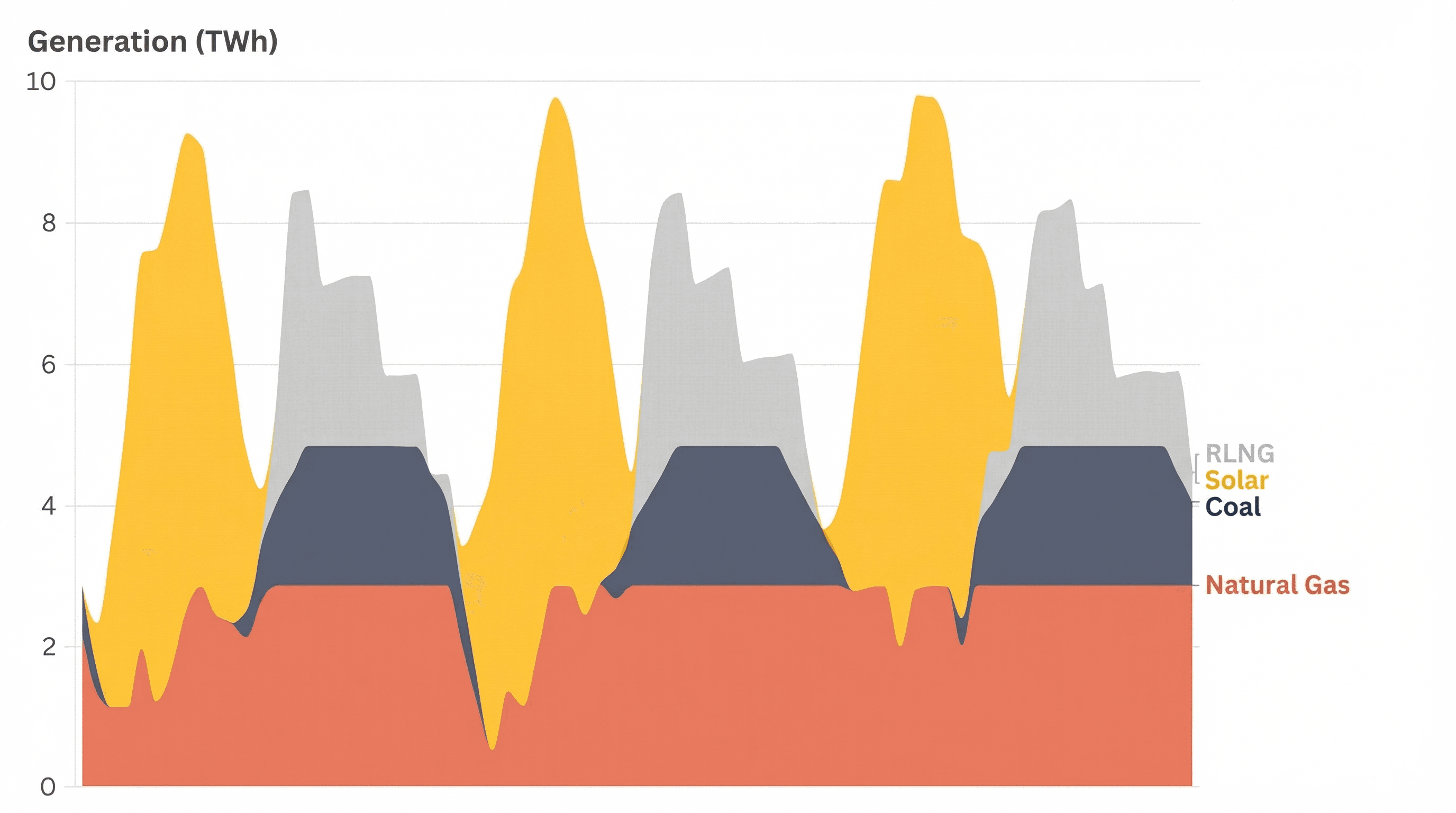
When the sun sets, solar generation falls to zero, putting pressure on the grid. With only 7.75 GW of grid-visible solar and no batteries, the evening peak is fully dependent on coal and bioenergy, while daytime solar surplus goes unused.
Source: Renewable First’s Scenario Builder results page
*Note: In the scenario builder, natural gas and bagasse are represented as bioenergy. To see the complete dispatch, visit the link to the Scenario Builder Model.
2026: Daytime solar, evening coal. The cost of no storage.
In 2026, the national grid has almost no flexibility. Without storage, daytime solar cannot meet evening demand.
When the price shock hits, RLNG generation falls by 94%, from 45.2 TWh to 2.7 TWh. The grid, however, does not turn to oil, which is already too expensive to run. Instead, coal surges from 1.7 TWh to 33.4 TWh, absorbing the bulk of the RLNG shortfall.
The mismatch between daytime solar and evening peak demand worsens the shortfall. During low-demand periods, surplus solar has nowhere to go.
RLNG operating costs fall from US$5.49bn to US$406m under the shock, but total variable costs rise from US$6.85bn to US$7.46bn as coal which is still expensive replaces RLNG. Emissions rise sharply from 18.4 Mt to 31.0 Mt (a 68% increase).
Table 1: Annual generation mix across all four scenarios (TWh).
.png)
Source: Renewable First’s Scenario Builder results pages (Scenario 1, 2, 3, 4)
By 2030, the system builds its way out of the crisis.
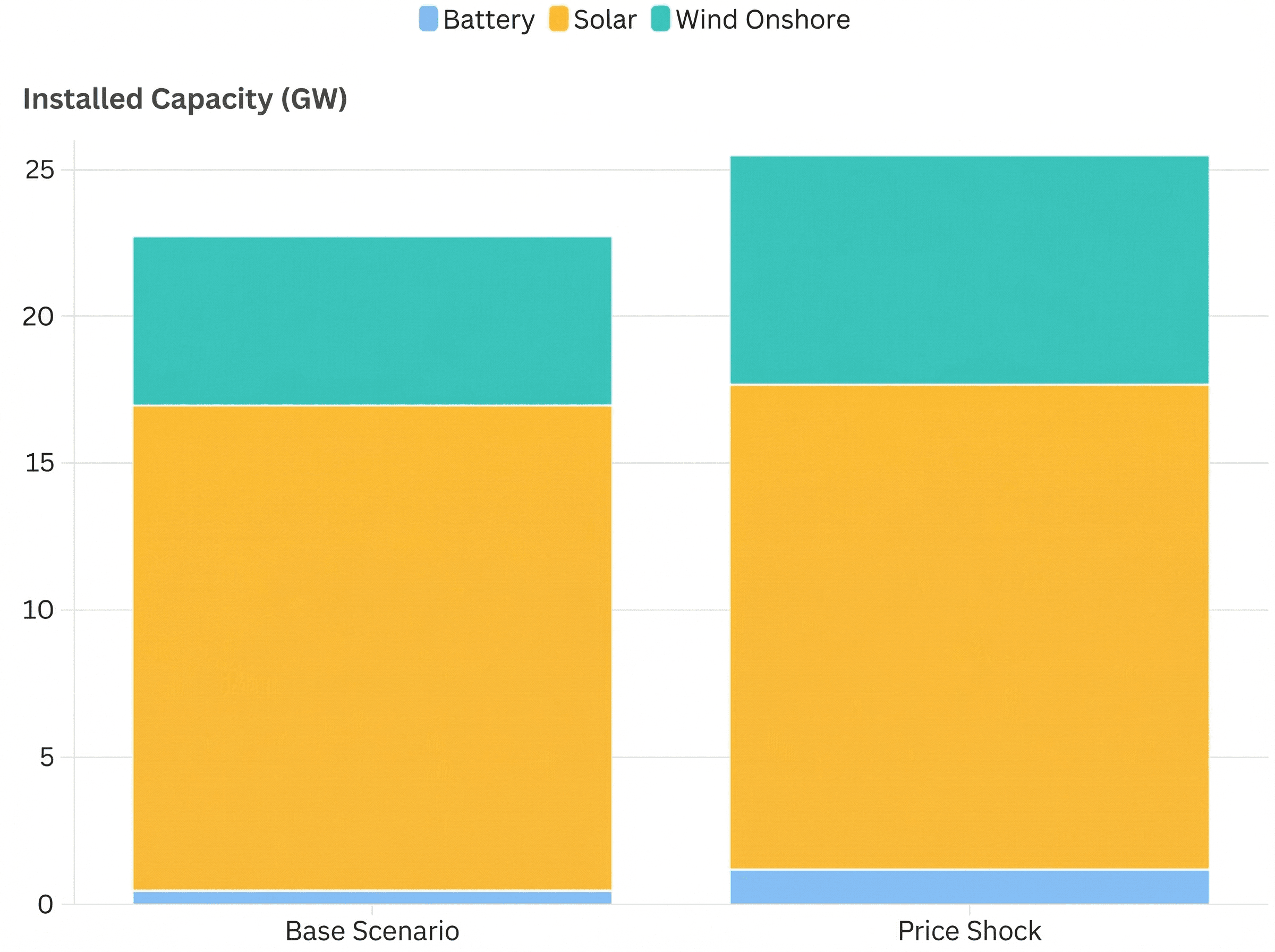
Faced with the same price shock, the 2030 system responds by investing in 1,165 MW of batteries and 2,056 MW of new wind. Source: Renewables First’s Scenario Builder results page
*Note: In the scenario builder, natural gas and bagasse are represented as bioenergy. To see the complete dispatch, visit the link to the Scenario Builder Model.
2030: batteries and wind reshape the grid’s exposure to price shocks
By 2030, solar capacity more than doubles, hydro expands, and demand grows to 157 TWh. With time to invest and build clean capacity along with batteries, fossil prices are driven out of the system.
The model builds 1,165 MW of battery storage, up from 451 MW in the baseline, and expands wind capacity by 2,056 MW (from 5,684 MW to 7,740 MW). The combined clean investment is approximately US$488m: US$144m for batteries and US$344m for additional wind.
This investment cuts RLNG operating costs by 93%, from US$3.09bn to US$218m. Wind generation rises 36%, and batteries shift excess daytime solar to the evening peak, reducing reliance on RLNG during high-price periods. Bioenergy, unaffected by the Hormuz disruption and cheaper than RLNG, provides a steady baseload presence across both 2030 scenarios. The focus of the shock response, however, remains RLNG: batteries and wind which absorb the bulk of the shortfall, keeping the system from falling back on coal.
By 2030, a price shock shifts the grid towards cleaner generation
Wind and battery-enabled solar absorb a significant share of the RLNG shortfall.
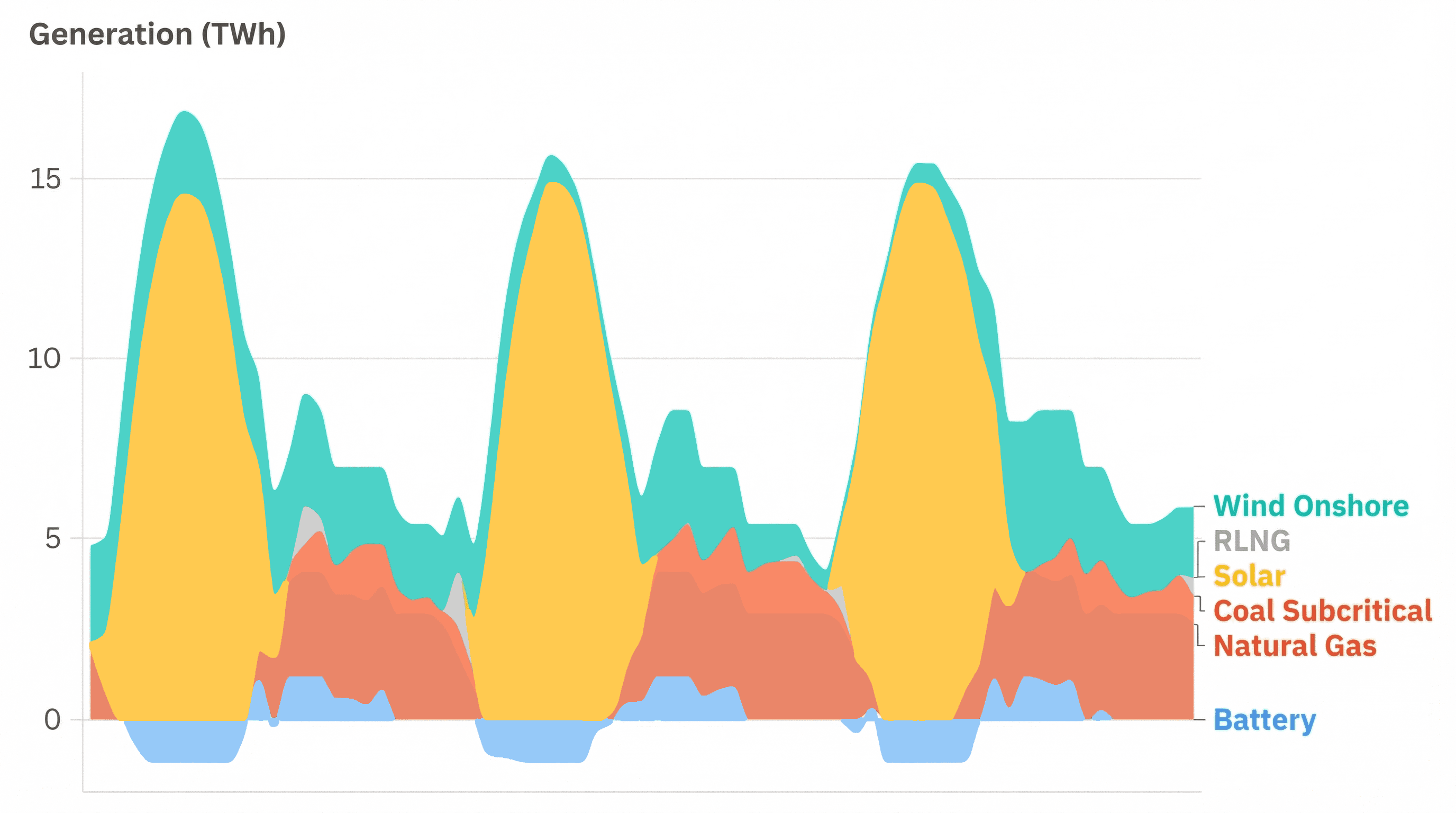
Source: Renewables First’s Scenario Builder results page
*Note: In the scenario builder, natural gas and bagasse are represented as bioenergy. To see the complete dispatch, visit the link to the Scenario Builder Model.
Conclusion
Battery storage is Pakistan’s most urgent grid investment
In 2026, when RLNG prices surge, the system turns to coal while excess solar in the day cannot be effectively utilised after sunset. The evening peak remains fully exposed to fossil fuel prices, and without batteries, daytime solar surplus cannot bridge the gap.
By 2030, a targeted US$488m investment fundamentally changes the equation. RLNG operating costs collapse from US$3.09bn to US$218m due to significant reductions in generation. Wind generation rises 36% to 19.7 TWh and battery capacity increases nearly 3 fold from 451 MW to 1,165 MW, shifting daytime solar to the evening peak.
A renewable-powered energy system shields Pakistan from volatile fossil fuel prices. Reduces exposure to supply shocks, and lowers geopolitical risk. The current Middle East conflict illustrates how fossil fuel dependence translates directly into fiscal stress, market volatility, and reduced policy space.
Pakistan's vulnerability, however, extends beyond the current crisis. Domestic RLNG reserves are depleting, and a significant share of coal is imported, meaning the grid's two main shock-absorbers today are themselves exposed to future supply and price disruptions. If coal prices spike as RLNG did, Pakistan would face an even sharper pivot toward oil-fired generation, the most expensive option available. The case for accelerating distributed solar and grid-scale storage is not just about the Hormuz crisis. It is about building a grid that is structurally insulated from any fossil fuel shock, wherever it originates.
Authors:
Abdul Rehman, Senior Associate – Energy Modelling, Renewables First
Abdul Karim Shah, Analyst – Grid and Distribution, Renewables First



.png)

.png)
.png)